About the Shudokan Martial Arts Association
The Shudokan Martial Arts Association (SMAA, Shudokan Budo-Kai) was founded in January 1994 by a group of martial artists who were concerned with promoting and safeguarding Nihon budo and koryu bujutsu--the traditional martial arts and ways of Japan. The original members of the SMAA were Karl Scott Sensei (karate-do seventh dan, aikido sixth dan), Nicklaus Suino Sensei (judo sixth dan, iaido eighth dan), H. E. Davey Sensei (jujutsu eighth dan), and the late Walter Todd Sensei (judo eighth dan, aikido sixth dan). From the original core group, the association has grown to include many of the preeminent practitioners of martial arts in and outside of Japan such as:
Otsuka Yasuyuki Soke (Headmaster of Meifu-Shinkage Ryu shuriken-jutsu)
Iwasaki Hisashi Soke (Headmaster of Kobori Ryu suiei-jutsu)
Sawai Atsuhiro Sensei (Kobori Ryu suiei-jutsu)
Suzuki Kunio Sensei (Nakamura Ryu and Toyama Ryu iaido, Wado Ryu karate-do)
Ohsaki Jun Sensei (Saigo Ryu aiki-jujutsu and Kodokan judo)
Stephen Fabian Sensei (Hontai Yoshin Ryu jujutsu, Toyama Ryu iaido)
Hunter Armstrong Sensei (Owari Kan Ryu sojutsu, Yagyu Shinkage Ryu kenjutsu, Shindo Muso Ryu jojutsu, and Goju Ryu karate-do)
Guy Power Sensei (Nakamura Ryu iaido and battodo)
Herb Wong Sensei (Shorin Ryu karate-do)
Richard Yamamoto Sensei (Kodokan judo)
Mr. Dave Lowry (Shindo Muso Ryu jojutsu, Yagyu Shinkage Ryu kenjutsu, and Aikikai aikido)
Mr. Wayne Muromoto (Takeuchi Ryu jujutsu, Muso Jikiden Eishin Ryu iaido)
And many others.
The SMAA is a small, fraternal organization with a decidedly noncommercial outlook on modern budo and koryu bujutsu. It includes separate divisions for karate-do, aikido, judo, traditional jujutsu, and iaido. Both associate membership (without rank) and regular membership (with rank) are available to individuals sincerely interested in researching and training in the classical martial systems of Japan. Regular international seminars, e-mail newsletters, a quarterly journal, a blog, access to this website, and examinations for dan/kyu ranking are benefits of membership. All members are bound by the SMAA Code of Ethics.
The leaders of the SMAA all have close ties to the martial community in Japan, or they live in Japan. Although they are reimbursed for their expenses, they receive no salaries. Their rewards lie in the friendships that are born within the SMAA and the exchange of knowledge that takes place as the result of SMAA membership.
What's in a Name?
Shudokan means "an Institution for Cultivating the Way." (Do, or "the way," refers philosophically to discovering the right and natural way to live. It is the same character found in budo--the "martial way;" sado--the ""way of tea," i.e. the tea ceremony; shodo--the "way of Japanese calligraphy;" as well as the names of various Japanese fine arts.)
It is interesting to note that no martial connotation is found in the appellation Shudokan, no reference to karate-do is contained in the name, and the name is used on occasion by schools of Japanese cultural arts that have no connection to budo. Actually, any "do" form, ranging from judo to karate-do to iaido, or even fine arts such as shodo, could be considered a vehicle for cultivating the way.
The SMAA Mon

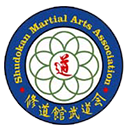
The emblem on this web site is inspired by the mon, or Japanese family crest. This general design was a collaboration between Michael Donnelly Sensei, H. E. Davey Sensei, and Kevin Heard Sensei. It was eventually incorporated into an official SMAA insignia, complete with English and Japanese lettering, that is used on SMAA uniform patches and other SMAA merchandise that members can purchase at our online store or via the online payments section of this website.
The SMAA mon has symbolic significance. The circle motif represents the martial artist's never-ending progress toward perfection, as once we start to travel on this circle, our path never stops. Notice as well the eight rings surrounding the central circle. Eight in Japanese martial culture has connotations of infinity, while the center circle symbolizes the individual martial artist, who resides in sea of limitless possibilities. He or she can only move in eight fundamental directions, whether attacking or defending (happo sabaki). Attacks can only be launched against the budoka from eight basic directions as well. And one's opponent can also be unbalanced at eight essential angles (happo kuzushi). Moreover, when wielding a sword or other weapon, the path of the sword will travel in one of eight primary directions (happo giri).
From judo to aikido to kenjutsu, the eight-way concept is a common and important idea. Yet, the eight circles are linked, thus indicating possible angles of movement that fall between the eight basic angles.
In this simple design, we're confirming an infinite potential available to individuals on the never-ending path toward perfection via modern budo and ancient bujutsu. In addition, the mon serves to remind SMAA members of the essentially circular movements of the arts they practice and the eight basic angles of evasion, attack, unbalancing, and weapon movement that are universal for most martial studies.
Objectives of the SMAA
- To promote and aid in the growth of Japan's traditional martial arts and ways.
- To assist the public in achieving spiritual growth and physical development through budo and koryu bujutsu training.
- To further friendship and understanding between Asian and Western martial artists.
- To establish goodwill and harmony among martial artists of various systems.
- To offer Western martial artists access to legitimate budo and koryu bujutsu organizations and teachers in Japan.
- To give practitioners of authentic budo and koryu bujutsu recognition for their years of devotion to these arts.